

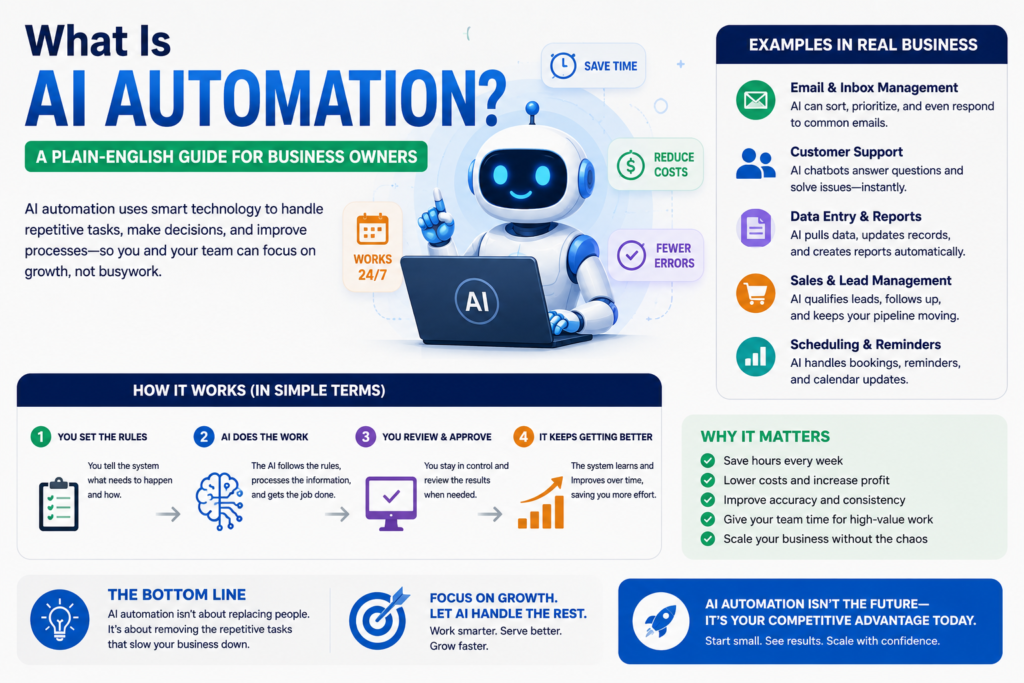
If you’ve been hearing the phrase ‘AI automation’ everywhere but still aren’t sure what it actually means for your business — not in theory, not in a tech demo, but in real daily operations — this guide is for you. We’re going to skip the jargon, skip the hype, and talk plainly about what AI automation is, what it can and can’t do, and how small and medium businesses across the United States are already using it to save time, cut costs, and grow faster.
| Who This Is For This guide is written for SMB owners, startup founders, and business leaders who are curious about AI automation but don’t have a technical background. No prior knowledge required. We’ll explain everything from first principles. |
Let’s Start With the Basics: What Is Automation?
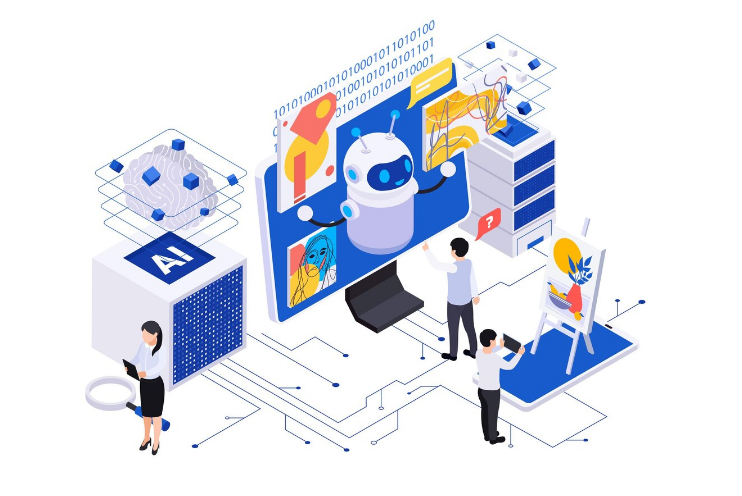
Before we add ‘AI’ to the equation, let’s be clear on what automation means in a business context. Automation is the use of technology to perform a task without human intervention. You’ve been benefiting from automation for years — email autoresponders, scheduled social media posts, automatic invoice reminders, online checkout processes. If a task happens on its own because a system was set up to trigger it, that’s automation.
Traditional automation is rule-based. If this happens, then do that. A customer fills out a form, they get a confirmation email. An invoice is unpaid after 30 days, a reminder is sent. These rules are simple and effective, but they can only handle situations you anticipated and pre-programmed.
That’s where AI changes everything.
So What Makes It ‘AI’ Automation?
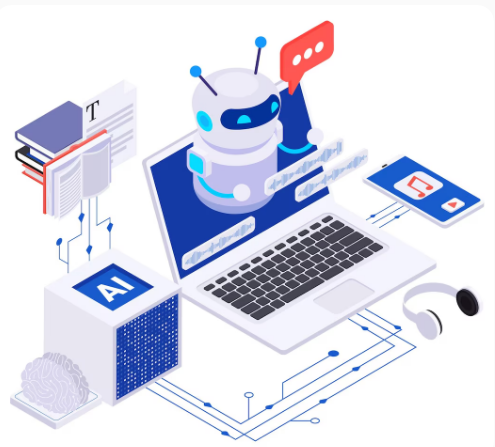
AI automation goes beyond fixed rules. It uses artificial intelligence — specifically machine learning and language models — to handle tasks that require judgment, context, and adaptability. Instead of just following a script, an AI-powered system can:
- Read and understand the content of an email, then route it to the right team member
- Analyze a customer inquiry and generate a helpful, accurate response without a human typing it
- Review sales data and flag which leads are most likely to convert based on behavioral patterns
- Monitor your operations data and alert you when something is trending in the wrong direction
- Generate reports, summaries, and first drafts of documents based on your data
The difference between traditional automation and AI automation is the difference between a vending machine and a skilled employee. A vending machine does exactly what you program it to do. A skilled employee reads the situation, applies judgment, and handles things you didn’t anticipate.
AI automation brings something close to that adaptability to business processes — at scale, without salaries, and without days off.
What Can AI Automation Actually Do for Your Business?
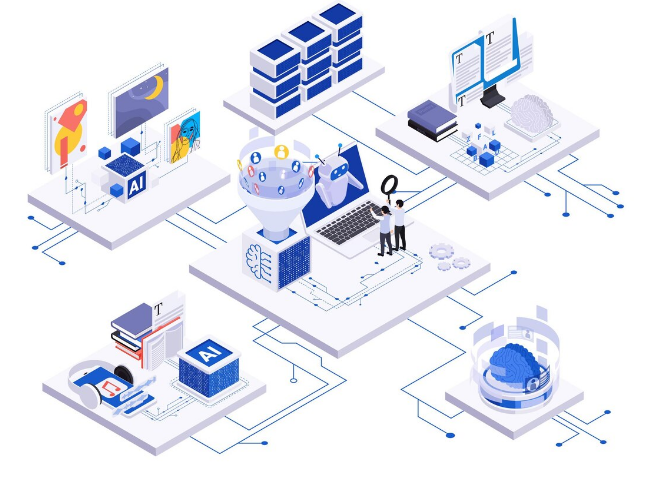
Let’s make this concrete. Here are the most common and highest-impact areas where AI automation is being deployed by SMBs and startups across the United States in 2026:
1. Sales and Lead Generation
AI can identify your highest-value leads based on behavior patterns, automate follow-up sequences that adapt based on how prospects engage, score leads in your CRM automatically, and alert your sales team to take action at exactly the right moment. The result: your sales team spends more time closing and less time chasing cold contacts.
2. Marketing and Customer Communication
Email campaigns that segment and personalize themselves based on recipient behavior. Social media content that gets scheduled, optimized, and analyzed without manual effort. Customer feedback that gets collected, categorized, and surfaced automatically. AI automation in marketing doesn’t replace your brand voice — it amplifies it by removing the manual execution burden from your team.
3. Customer Support
AI agents can handle a significant percentage of incoming customer inquiries — answering common questions, processing returns or cancellations, booking appointments, and escalating complex issues to a human — around the clock, without wait times. For many SMBs, this is the single highest-ROI automation they implement.
4. Operations and Internal Workflows
Document routing, approval workflows, data entry, inventory alerts, invoicing, reporting — the administrative tasks that eat up enormous amounts of employee time are prime automation targets. When these are automated, your team gets back to work that actually requires their skills and judgment.
5. Data and Reporting
AI can connect your systems — your CRM, your accounting software, your marketing platform, your operations tools — and produce consolidated reports, dashboards, and alerts automatically. Instead of someone manually pulling data from four different places every Monday morning, the insight is waiting for you when you start your week.
Before and After: AI Automation in Practice
Here’s what AI automation looks like in real-world terms for a typical growing business:
| Business Process | Without Automation | With AI Automation |
| Lead Follow-Up | Sales rep manually emails each new lead within 24–48 hrs — if they remember | AI sends personalized follow-up within minutes, adjusts sequence based on opens and clicks |
| Customer Support | Staff answer the same questions repeatedly via email and phone during business hours only | AI agent handles 60–70% of inquiries 24/7, escalates complex cases to humans |
| Invoicing & AR | Finance team manually generates invoices and sends reminders | Invoices auto-generated, payment reminders sent on schedule, overdue flagged automatically |
| Weekly Reporting | Someone spends 2–4 hours pulling data from multiple tools to build a report | Automated dashboard updates in real-time; report delivered to inbox every Monday morning |
| New Employee Onboarding | HR team manually sends welcome emails, tracks document returns, schedules meetings | Onboarding workflow triggers automatically: documents sent, signatures tracked, meetings booked |
| The Real ROI Studies consistently show that businesses implementing AI automation recover an average of 6–10 hours per week per employee from repetitive administrative tasks. For a 10-person team, that’s 60–100 hours of productive capacity returned to your business every single week — without a single new hire. |
What AI Automation Is Not

Before you start imagining a fully automated business that runs itself, let’s be honest about what AI automation is not:
It is not a replacement for human judgment in complex situations
AI automation excels at high-volume, well-defined tasks. It does not replace the judgment of an experienced salesperson in a nuanced negotiation, the empathy of a customer service rep handling an upset client in a sensitive situation, or the strategic thinking of a leader navigating an uncertain market. The best AI automation setups amplify human capability — they don’t eliminate the need for humans.
It is not a one-time setup that runs forever without maintenance
AI-powered systems require monitoring, updating, and periodic refinement. Your business changes, your customers change, and your automation needs to evolve with them. Treating automation as a ‘set it and forget it’ investment is one of the most common mistakes businesses make — and it’s one of the main reasons automation projects fail.
It is not exclusively for large enterprises
This is perhaps the most persistent myth. AI automation is not just for companies with large IT departments and seven-figure technology budgets. In 2026, the tools are accessible, the implementation costs have dropped dramatically, and the ROI for SMBs is often faster than for large enterprises precisely because small businesses have less bureaucracy and can move more quickly.
Is Your Business Ready for AI Automation?
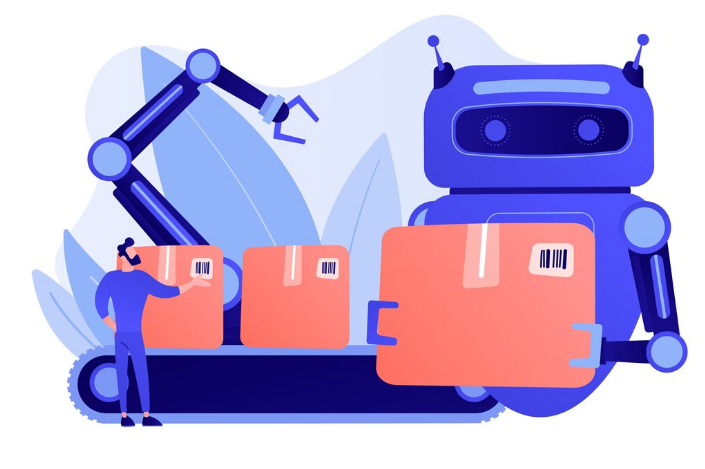
Here are five indicators that your business is a strong candidate for AI automation right now:
- Your team is spending significant time on repetitive, process-driven tasks that follow predictable patterns
- You’re losing leads because follow-up is inconsistent or delayed
- Your customer support volume is growing faster than your team’s capacity
- You’re making business decisions based on gut instinct because your data is scattered across disconnected tools
- You’re hitting a growth ceiling that more headcount alone won’t solve
If two or more of these describe your business, you have automation opportunities that are almost certainly costing you money right now — in lost revenue, wasted time, and unnecessary overhead.
How to Get Started With AI Automation

The most common mistake businesses make when approaching AI automation is trying to automate everything at once. This leads to overwhelm, scope creep, and projects that never reach completion.
The right approach is to start with your highest-pain, highest-volume process — the one that’s costing the most time or creating the most friction — and build from there. A successful first automation builds confidence, generates measurable ROI, and creates the organizational buy-in that makes subsequent automation projects faster and easier.
A professional AI automation consultant can map your current operations, identify your highest-value automation targets, and build a phased implementation roadmap that delivers results without disrupting your business. That’s exactly what the team at Growth That Talks does for SMBs and startups across the United States.
Frequently Asked Questions
Do I need technical expertise to implement AI automation in my business?
No. The right AI automation implementation partner handles the technical side entirely. Your job is to understand your business processes, articulate what problems you’re trying to solve, and provide access to your systems. A good consultant translates your operational reality into a technical solution — you don’t need to understand how it works under the hood to benefit from it.
Will AI automation work with the tools and software I already use?
In most cases, yes. Modern AI automation tools are built to integrate with the most widely used business platforms — CRMs like Salesforce and HubSpot, email platforms like Gmail and Outlook, project management tools like Asana and Monday, accounting software like QuickBooks and Xero, and many others. The integration landscape in 2026 is more mature than ever, and a skilled automation team will assess your existing stack and build solutions that work with what you have.
How long does it take to implement AI automation?
Simple automations — like an automated lead follow-up sequence or an invoice reminder workflow — can be implemented in days. More complex projects involving multiple system integrations, custom AI agents, and multi-step workflows typically take four to twelve weeks, depending on scope. A phased approach, starting with quick wins, is almost always the right strategy for businesses implementing automation for the first time.
How do I measure the ROI of AI automation?
The most common ROI metrics include: hours recovered per week (multiply by average hourly cost to get a dollar figure), lead conversion rate improvement, customer support resolution time, reduction in operational errors, and revenue attributed to faster follow-up or improved customer experience. Your automation partner should help you define success metrics before implementation begins and track them throughout.
Is AI automation safe for my business data?
Data security is a legitimate concern and should be a central part of any automation implementation. Reputable AI automation platforms comply with SOC 2 standards, use encrypted data transmission, and provide granular access controls. A responsible implementation partner — like Growth That Talks — will always evaluate data handling practices, ensure compliance with relevant regulations (GDPR, CCPA, HIPAA where applicable), and build your automation stack with security as a non-negotiable requirement.
The Businesses That Will Win in 2027 Are Automating Today
AI automation is not a technology trend for the distant future. It is a present, practical, and powerful set of tools that businesses like yours are using right now to work smarter, grow faster, and compete against companies much larger than themselves.
The gap between businesses that have embraced AI automation and those that haven’t is already wide — and it’s growing every quarter. The good news is that if you’re reading this, you’re at the beginning of your automation journey, not behind it. The right time to start is now.
Ready to find out what AI automation could do for your business? Growth That Talks offers a free automation discovery call for SMBs and startups across the United States. In 30 minutes, we’ll map your biggest operational bottlenecks, identify your highest-value automation opportunities, and give you a clear picture of what’s possible — no technical expertise required on your part.